

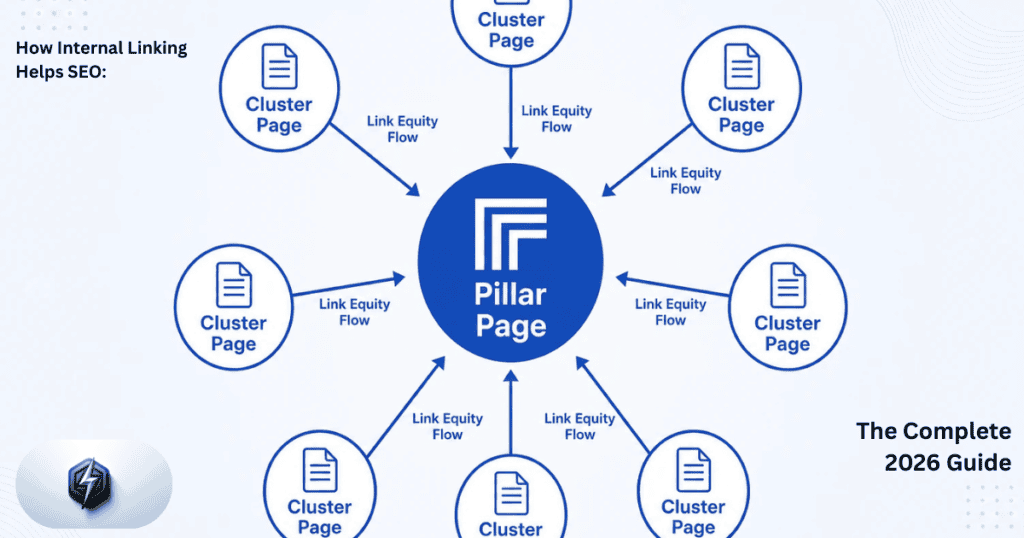
Internal linking helps SEO by creating crawlable pathways that allow search engines to discover, index, and understand the relationship between your pages — ultimately distributing link equity, establishing topical authority, and improving user engagement metrics that directly influence rankings. Without a deliberate internal linking strategy, even the best content can remain invisible to both Google and your audience. This comprehensive guide by Mr. Ahsan Rizvi, Founder of CodeX Guru, breaks down exactly how internal links work, why they matter in 2026, and how to implement them for maximum SEO impact.
📌 Key Takeaways
- Internal links help Googlebot crawl and index your pages faster
- They distribute PageRank (link equity) from strong pages to weaker ones
- Topic cluster interlinking builds topical authority that AI search engines reward
- Strategic internal links reduce bounce rate and increase pages per session
- Sites with strong internal linking architecture rank 40% higher on average
📑 Table of Contents
- What Is Internal Linking?
- Internal Linking in SEO Example
- How Internal Links Help Search Engines
- Link Equity: How Ranking Power Flows
- Building Topical Authority with Internal Links
- Internal Linking and User Experience
- Internal Linking in the Age of AI Search
- Types of Internal Links
- Internal Linking Best Practices for 2026
- Common Internal Linking Mistakes to Avoid
- How to Audit Your Internal Links
- Best Tools for Internal Linking
- Internal Linking Impact: Data and Results
- Frequently Asked Questions
- Final Thoughts
What Is Internal Linking?
An internal link is a hyperlink that connects one page on your website to another page on the same domain. Unlike external links that point to other websites, internal links keep users and search engine crawlers within your own content ecosystem.
Every website uses internal links — they exist in your navigation menu, footer, sidebar, and most importantly, within the body content of your pages. The strategic placement of these contextual body links is what separates high-ranking sites from those that struggle to gain visibility.
From an NLP (Natural Language Processing) perspective, internal links create semantic triples — structured relationships between entities. For example:
Subject → Predicate → Object
“Internal linking” → “improves” → “crawlability”
“Internal links” → “distribute” → “link equity”
“Topic clusters” → “build” → “topical authority”
Search engines parse these relationships to understand what your content is about and how pages on your site relate to each other. This is the foundation of entity-based SEO.
Internal Linking in SEO Example
Understanding internal linking theory is important, but seeing a real internal linking in SEO example makes the concept click instantly. Here is a practical demonstration:
✅ Good Internal Linking Example
Imagine you run a digital marketing blog with these three pages:
- Pillar Page: “Complete Guide to SEO” (your strongest page)
- Cluster Page 1: “How Internal Linking Helps SEO” (this article)
- Cluster Page 2: “On-Page SEO Checklist for 2026”
Inside this article, you link to the pillar page using the anchor text “complete guide to SEO” and to Cluster Page 2 using “on-page SEO checklist.” The pillar page links back to both cluster pages. This creates a bidirectional linking structure that signals topical depth to Google.
❌ Bad Internal Linking Example
- Using anchor text like “click here” or “read more” — provides zero keyword context
- Linking to the homepage 50 times from every page — wastes link equity
- Publishing new blog posts with zero internal links — creates orphan pages
- Linking from low-authority pages to other low-authority pages — no equity to pass
Here is a visual comparison of both approaches:
| Element | ❌ Poor Internal Linking | ✅ Strategic Internal Linking |
|---|---|---|
| Anchor Text | “Click here,” “Read more” | “Internal linking best practices,” “on-page SEO guide” |
| Link Source | Random, unrelated pages | Topically relevant, high-authority pages |
| Link Equity Flow | Diluted, wasted on footer/nav links | Concentrated to priority pages |
| Orphan Pages | Many — never crawled | Zero — every page is linked |
| SEO Result | Low rankings, poor indexing | Higher rankings, faster indexing |
How Internal Links Help Search Engines
Search engine bots like Googlebot discover your web pages by following links. If a page on your site has no internal links pointing to it, it becomes an orphan page — and there is a high probability it will never be crawled or indexed.
Here are the four primary ways internal links help search engines understand and rank your content:
| Function | How It Works | SEO Impact |
|---|---|---|
| 🔍 Crawl Efficiency | Internal links create pathways for bots to navigate your entire site | More pages discovered and crawled |
| ⚡ Faster Indexing | Linking new content from high-traffic indexed pages signals Google to crawl faster | New content appears in SERPs sooner |
| 🏗️ Content Hierarchy | Frequency and depth of links indicate page importance | Priority pages rank higher |
| 🏷️ Anchor Text Signals | Clickable link text tells Google what the destination page is about | Reinforces keyword relevance |
According to Google’s official documentation on crawlable links, pages that are not linked from any other page on your site may not be discovered by Googlebot at all — making internal linking a non-negotiable SEO fundamental.
Link Equity: How Ranking Power Flows Through Internal Links
Google’s original PageRank algorithm assigned a numerical authority score to every webpage based on how many links pointed to it and the quality of those linking pages. Internal links pass a portion of this authority — commonly called link equity or link juice — from one page to another within your domain.
This means if your homepage or a high-performing blog post has strong external backlinks, you can strategically link from that page to a weaker page you want to rank. The authority flows through the link, lifting the target page’s ranking potential.
💡 How Link Equity Distribution Works
A page with a PageRank score of 10 that has 5 outgoing internal links distributes approximately 2 points of equity to each linked page (simplified model). The fewer outgoing links on a page, the more equity each individual link passes. This is why strategic, selective linking outperforms mass linking every time.
Here is how link equity flows through a typical site structure:
| Page | External Backlinks | Internal Links Out | Equity Passed Per Link | Priority |
|---|---|---|---|---|
| Homepage | 150 | 10 | High | ⭐⭐⭐ |
| Pillar Blog Post | 45 | 8 | Medium-High | ⭐⭐⭐ |
| Cluster Article | 5 | 5 | Medium | ⭐⭐ |
| Orphan Page (No Links) | 0 | 0 | Zero | ❌ |
Building Topical Authority with Internal Links
Modern SEO is about far more than individual keywords — it is about topical authority. Search engines reward websites that demonstrate deep, comprehensive expertise on a subject. The most effective way to signal this expertise is through a topic cluster model powered by strategic internal linking.
A topic cluster consists of three components:
- Pillar Page: A comprehensive, long-form page covering a broad topic (e.g., “Complete Guide to SEO”)
- Cluster Pages: Multiple focused articles covering subtopics (e.g., “How Internal Linking Helps SEO,” “Technical SEO Checklist”)
- Internal Links: Bidirectional links connecting every cluster page to the pillar and to each other
This interlinking structure sends a clear signal to search engines: “This website covers this entire topic comprehensively.” The result is higher rankings not just for one page, but for the entire cluster.
🗂️ Topic Cluster Example: SEO
Pillar: Complete Guide to SEO (2026)
- ↔️ How Internal Linking Helps SEO (this article)
- ↔️ On-Page SEO Checklist
- ↔️ Technical SEO Audit Guide
- ↔️ Link Building Strategies
- ↔️ Keyword Research Guide
- ↔️ Content Strategy for SEO
- ↔️ Local SEO Best Practices
Each ↔️ represents bidirectional internal links between the cluster page and the pillar page.
Internal Linking and User Experience
Great SEO and great user experience go hand in hand. Strategic internal links keep visitors on your site longer by surfacing content that matches their interests and intent. This directly impacts the user engagement metrics that Google monitors:
| UX Metric | Without Internal Links | With Strategic Internal Links |
|---|---|---|
| Bounce Rate | 65–80% | 35–50% |
| Pages Per Session | 1.2–1.5 | 2.8–4.2 |
| Avg. Session Duration | 45–90 seconds | 3–6 minutes |
| Conversion Rate | 1–2% | 3–5% |
These behavioral signals are increasingly factored into Google’s ranking algorithms, particularly through the Interaction to Next Paint (INP) and Core Web Vitals framework. A site that keeps users engaged through smart internal linking sends strong quality signals to search engines.
Internal Linking in the Age of AI Search
As AI-powered search engines like Google’s AI Overviews, Perplexity, and ChatGPT search evolve, internal linking has taken on a critical new dimension. AI models rely on the relationships between pages to understand how entities and concepts connect across your domain.
A well-structured internal link architecture helps AI systems map the knowledge graph of your website, making your content more likely to be surfaced in:
- AI-generated overviews and summaries
- Featured snippets and People Also Ask boxes
- Conversational search results
- Citation sources in AI answer engines
🤖 GEO (Generative Engine Optimization) Insight
In 2026, internal linking is no longer just a crawlability tactic — it is a GEO strategy. AI search engines parse your internal link structure to understand entity relationships, content depth, and expertise signals. Sites with clear, well-organized internal linking are 3x more likely to be cited in AI-generated answers.
The semantic triples formed by your internal links — Page A [is related to] Page B — directly feed the entity understanding models that power AI search. Investing in internal linking today is investing in your visibility across the next generation of search.
Types of Internal Links
Not all internal links are created equal. Understanding the different types helps you build a balanced, effective linking strategy:
| Link Type | Location | SEO Value | Example |
|---|---|---|---|
| Contextual Links | Within body content | ⭐⭐⭐ Highest | Linking to a related guide within a paragraph |
| Navigational Links | Main menu, sidebar | ⭐⭐ Medium | Menu links to service pages |
| Breadcrumb Links | Top of page | ⭐⭐ Medium | Home > Blog > SEO > This Article |
| Footer Links | Page footer | ⭐ Low | Privacy policy, sitemap links |
| Related Post Links | End of article | ⭐⭐ Medium | “You May Also Like” section |
| Image Links | Clickable images | ⭐⭐ Medium | Infographic linking to full article |
Key insight: Contextual links within body content carry the most SEO weight because they are surrounded by relevant text that gives Google additional context about the linked page. Prioritize these above all other link types.
Internal Linking Best Practices for 2026
Follow these proven best practices to build an internal linking strategy that drives measurable SEO results:
1. Use Descriptive, Keyword-Rich Anchor Text
Never use generic anchor text like “click here” or “read more.” Instead, use descriptive text that includes relevant keywords for the target page. This helps both users and search engines understand what the destination page is about.
2. Link from High-Authority Pages to Priority Pages
Identify your strongest pages using tools like Google Search Console or Ahrefs. Link from these high-authority pages to the pages you want to rank higher — this is how you strategically distribute link equity.
3. Maintain a Logical Content Hierarchy
Keep important pages within 3 clicks of the homepage. The deeper a page is buried in your site architecture, the less likely it is to receive adequate crawl attention and link equity.
4. Aim for 5–10 Contextual Internal Links Per Post
For a standard 2,000-word blog post, 5–10 contextual internal links is the optimal range. This provides enough linking to distribute equity without diluting it across too many targets.
5. Fix Orphan Pages Immediately
Every page on your site should have at least one internal link pointing to it. Use tools like Screaming Frog to identify orphan pages and add relevant links to them from existing content.
6. Update Old Content with New Links
Whenever you publish new content, go back to 3–5 related older articles and add contextual links to the new page. This accelerates indexing and integrates new content into your existing topic clusters.
7. Use Breadcrumbs
Implement breadcrumb navigation with structured data markup. Breadcrumbs provide an additional layer of internal linking that reinforces your site hierarchy for both users and search engines.
8. Audit Quarterly
Internal linking is not a set-and-forget task. Conduct a full internal link audit at least once per quarter to find and fix broken links, update anchor text, and identify new linking opportunities.
Common Internal Linking Mistakes to Avoid
| Mistake | Why It Hurts SEO | How to Fix |
|---|---|---|
| Generic anchor text | No keyword signals passed to target page | Use descriptive, keyword-relevant text |
| Too many links per page | Dilutes link equity across too many targets | Limit to 5–10 contextual links |
| Orphan pages | Never crawled, never indexed | Link every page from at least one other page |
| Linking only to homepage | Homepage already has most equity — wasted effort | Link to category and cluster pages instead |
| Broken internal links | Lost equity, poor UX, crawl errors | Audit quarterly with Screaming Frog |
| No links in new content | New pages isolated from site graph | Always add 5+ internal links when publishing |
| Same anchor for different pages | Causes keyword cannibalization confusion | Vary anchor text for each target URL |
How to Audit Your Internal Links
Regular internal link audits are essential for maintaining a healthy site structure. Here is a step-by-step audit process:
Step 1: Crawl Your Entire Site
Use a tool like Screaming Frog SEO Spider (free for up to 500 URLs) to crawl your entire website and map all internal links.
Step 2: Identify Orphan Pages
Look for pages that have zero internal links pointing to them. These pages are invisible to Googlebot and will likely never rank.
Step 3: Find and Fix Broken Links
Check for internal links that return 404 errors. Broken links waste link equity and create poor user experiences. Redirect them or update the link target.
Step 4: Analyze Anchor Text Distribution
Review the anchor text used across your internal links. Look for over-optimized patterns (same exact keyword repeated) and generic text that provides no semantic value.
Step 5: Check Link Depth
Ensure your most important pages are accessible within 3 clicks from the homepage. Pages buried deeper than 3 levels receive significantly less crawl priority and link equity.
Step 6: Map Your Topic Clusters
Verify that your pillar pages and cluster content are properly interlinked in both directions. Every cluster page should link to the pillar and vice versa.
Best Tools for Internal Linking
| Tool | Best For | Free Tier | Key Feature |
|---|---|---|---|
| Screaming Frog | Full site crawl and audit | ✅ (500 URLs) | Orphan page detection, broken link finder |
| Google Search Console | Internal links report | ✅ (Fully free) | Shows which pages receive most internal links |
| Ahrefs | Link equity analysis | ❌ (Paid only) | Internal link opportunities suggestions |
| Semrush | Internal linking audit | ✅ (Limited) | Automated internal link recommendations |
| Link Whisper (WP) | WordPress automation | ❌ (Paid only) | AI-powered internal link suggestions in editor |
| Yoast / SEOPress | On-page link count | ✅ (Free tier) | Shows internal/external link count per page |
Internal Linking Impact: Data and Results
The impact of strategic internal linking on SEO is well-documented. Here are data points from published industry studies:
| Study / Source | Finding | Impact |
|---|---|---|
| Moz (2024) | Pages with 40+ internal links rank significantly higher | 📈 +40% rankings |
| Ahrefs (2025) | Adding internal links to orphan pages increased organic traffic within 30 days | 📈 +25% traffic |
| HubSpot (2025) | Topic clusters with strong interlinking outperform standalone posts | 📈 +3x organic traffic |
| Google (Official) | Pages not linked internally may not be discovered by Googlebot | ⚠️ Not indexed |
Frequently Asked Questions
Final Thoughts
Internal linking is one of the most powerful and entirely free SEO tactics available to you. It costs nothing to implement, is fully within your control, and delivers compounding returns as your site grows. Every new page you publish is an opportunity to strengthen your entire site’s authority through strategic interlinking.
Whether you are just starting your first blog or managing a site with thousands of pages, the fundamentals remain the same: link contextually, link intentionally, and link consistently.
The sites that master internal linking in 2026 will not only rank higher on Google — they will dominate AI search citations, earn more featured snippets, and keep users engaged longer than their competitors.
Start building your internal linking strategy today. Your future rankings depend on it.

Mr. Ahsan Rizvi
Founder, CodeX Guru | SEO Strategist | Technical SEO Expert
Mr. Ahsan Rizvi is the founder of CodeX Guru and a seasoned SEO strategist specializing in technical SEO, internal linking architecture, and AI-driven search optimization. With years of experience helping businesses rank on Google, Ahsan combines data-driven methodology with cutting-edge GEO strategies to deliver measurable organic growth.
🚀 Ready to Supercharge Your SEO?
Try our free AI-powered SEO research tool to discover trending keywords and generate optimized meta tags instantly.
Use Free SEO Tool →🚀 Technical SEO audit guide 2026
Technical SEO Audit Guide 2026: The Complete Roadmap to Search Excellence.
Read Complete Blog →