

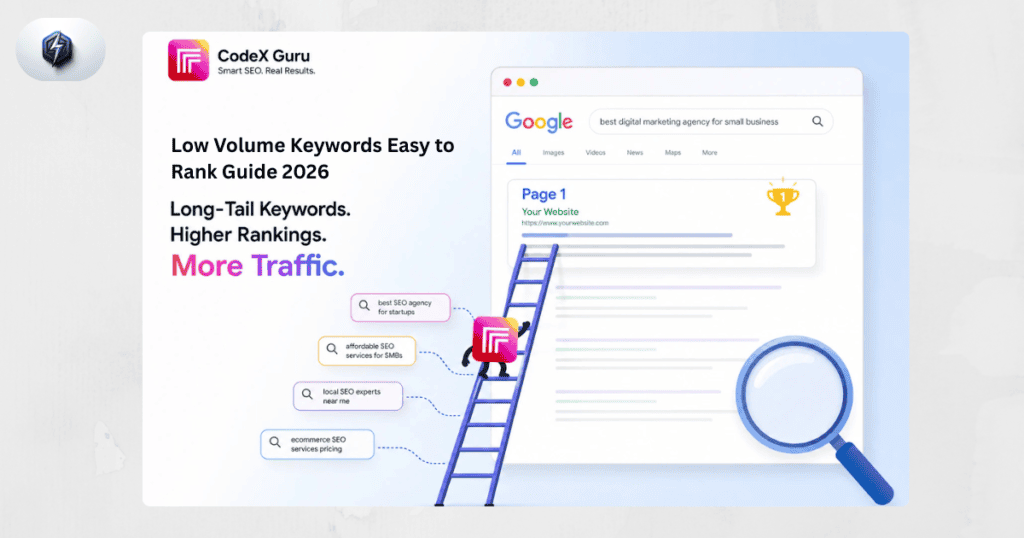
Low-volume keywords are easier to rank on Google because they have less competition, clearer search intent, and often need zero backlinks. If your website is new or small, these keywords give you the fastest path to page 1. Instead of fighting big brands for terms with millions of searches, you target specific phrases that fewer websites bother with. The result? You rank faster, attract visitors who actually want what you offer, and build your site’s authority one win at a time. In this guide, updated for July 2026, you will learn exactly why low-volume keywords work, how to find them step by step, and see a real case study where a single page reached Google’s top 10 within two months.
What Are Low-Volume Keywords?
Low-volume keywords are search phrases that get a small number of searches each month. Most SEO professionals define them as keywords with 10 to 500 monthly searches. Some stretch that number to 1,000.
These keywords are usually longer phrases. They have 3, 4, 5, or even more words. That is why people also call them long-tail keywords.
Here is a simple way to understand the difference:
| Keyword Type | Example | Monthly Searches | Competition |
|---|---|---|---|
| High-volume (short-tail) | “study abroad” | 50,000+ | Very High |
| Medium-volume | “study abroad from Pakistan” | 1,000–5,000 | High |
| Low-volume (long-tail) | “study in Latvia from Pakistan” | 10–200 | Very Low |
Notice something? The longer and more specific the keyword gets, the fewer people search for it. But fewer searches also means fewer competitors. And that is where your opportunity lives.
Let me break this down into simple reasons. Each one builds on the last.
1. There Is Less Competition
This is the biggest reason. When a keyword gets 50,000 searches per month, hundreds or thousands of websites try to rank for it. Big brands. Old websites. Sites with thousands of backlinks.
When a keyword gets 50 searches per month? Most websites ignore it. They think it is too small to bother with. That means you are competing against fewer sites. Often, the sites that do rank for these terms have weak content, poor SEO, or thin pages. You can beat them with a single well-written post.
Think of it this way: Would you rather be one of 1,000 runners in a race, or one of 5?
2. You Often Need Zero Backlinks
Backlinks are links from other websites pointing to yours. They are one of Google’s top ranking factors. For competitive keywords, you might need 50, 100, or even 500+ backlinks to reach page 1.
For low-volume keywords? Many of them rank with zero backlinks. If your content matches what the searcher wants and covers the topic well, Google will rank it based on content quality and on-page SEO alone.
This is a game-changer for new websites that have not built a backlink profile yet.
3. Search Intent Is Crystal Clear
When someone searches “study abroad,” what do they want? It is hard to tell. Maybe they want:
- General information about studying abroad
- A list of countries
- Scholarship options
- Application steps
- Visa requirements
But when someone searches “study in Latvia from Pakistan,” their intent is obvious. They are a Pakistani student. They want to study in Latvia. They need a guide that covers the process, costs, universities, and visa steps for their specific situation.
When intent is clear, you can write content that matches it perfectly. Google rewards that match with higher rankings.
4. Google Rewards Topical Relevance Over Domain Authority
You do not need to be Wikipedia or Forbes to rank for these terms. Google’s algorithm has evolved. It now values topical authority — how deeply your website covers a specific subject.
If your site has 10 detailed posts about studying abroad from Pakistan, Google sees you as a topical expert in that niche. That expertise helps every related low-volume keyword rank better.
This is called the compound effect. Ranking for one low-volume keyword makes it easier to rank for the next related one. Over time, your cluster of pages builds authority that even high-competition keywords start to notice.
5. Faster Ranking Timelines
High-competition keywords can take 6 to 12 months to rank — sometimes longer. Low-volume keywords? You can see results in 2 to 8 weeks.
I am not guessing here. I have proof. Let me show you.
Real Case Study: Ranking on Page 1 in Under Two Months
I run a study-abroad consulting brand called Career Connection Consulting. We help Pakistani students apply to universities in Europe, including Latvia.
In early 2026, we published a comprehensive guide:
📄 Study in Latvia from Pakistan
Here is what happened:
| Detail | Data |
|---|---|
| Focus Keyword | study in Latvia from Pakistan |
| Estimated Monthly Volume | Very low (under 200 searches/month) |
| Keyword Difficulty | Low |
| Time to Page 1 | Approximately 2 months |
| Current Position Range | Fluctuates between position 1 and 9 |
| Backlinks Built | Minimal to none specifically for this page |
| Content Type | Long-form comprehensive guide |
What We Did Right
- Matched search intent exactly — A Pakistani student searching this phrase needs a complete guide. We gave them everything: universities, costs, visa process, eligibility, and step-by-step instructions.
- Covered the topic deeply — We did not write a thin 300-word post. The guide is comprehensive. It answers every question a student would have.
- Used on-page SEO fundamentals — Proper heading structure, keyword in the title and URL, internal linking, and optimized meta description.
- Published on a niche-relevant website — Career Connection Consulting is a study-abroad brand. Google recognizes that our content fits our site’s overall topic.
- Targeted a keyword that big competitors ignored — Major education websites focus on broad terms like “study in Europe” or “study abroad scholarships.” They do not create hyper-specific pages for “study in Latvia from Pakistan.”
The Result
Within roughly two months, the page reached Google’s first page. It has been defending positions 1 through 9 since then. No expensive link-building campaign. No paid ads. Just a well-written page targeting a keyword that nobody else fought for.
This is the power of low-volume keywords.
The Strategic Framework: 80/20 Rule for Keywords
The 80/20 rule (also called the Pareto Principle) applies beautifully to SEO keyword strategy:
80% of your organic traffic results will come from 20% of your keyword efforts — when you choose the right keywords.
Here is what that looks like in practice:
| Strategy | Effort Level | Expected Result |
|---|---|---|
| Targeting 5 high-volume competitive keywords | Very High (months of link building, content, and waiting) | Maybe 1 ranks on page 1 after 12+ months |
| Targeting 50 low-volume keywords in clusters | Moderate (focused content creation) | 20–30 could rank on page 1 within 2–3 months |
The math is simple. 50 low-volume keywords each bringing 20–50 visitors per month = 1,000 to 2,500 monthly visitors. And these visitors often convert better because their intent is specific.
How to Find Low-Volume Keywords Step by Step
You do not need expensive tools to start. Here are methods ranked from free to paid.
Method 1: Google Autocomplete (Free)
Go to Google. Start typing your main topic. Do not press Enter. Watch the suggestions that drop down.
For example, type:
- “study in Latvia…” → Google suggests “from Pakistan,” “cost,” “requirements,” “for international students”
- “how to apply…” → Google suggests specific long-tail completions
Each suggestion is a real query that people search for. Many of them are low-volume, low-competition keywords.
Method 2: Google’s “People Also Ask” (Free)
Search for your main keyword. Look for the “People Also Ask” box on the search results page. Each question is a keyword opportunity.
Click on one question. More questions appear. You can extract 10 to 20 keyword ideas from a single search.
Method 3: Google’s “Related Searches” (Free)
Scroll to the bottom of any Google search results page. You will see “Related searches.” These are keyword variations that Google associates with your query.
Write them all down. They are gold for content planning.
Method 4: Google Keyword Planner (Free with a Google Ads Account)
Google Keyword Planner shows search volume ranges and competition levels. Enter your seed keyword, and it generates a list of related terms with their data.
Filter by low competition and low to medium search volume. Export the list and pick keywords relevant to your niche.
Method 5: Reddit and Quora Mining (Free)
Go to Reddit or Quora. Search for your topic. Read the questions people ask. These questions are often exact long-tail keywords that you can target.
For example, on Reddit’s r/SEO, someone asked: “What do people generally consider low-volume and low difficulty?” That question itself contains keyword ideas.
Method 6: Ahrefs, SEMrush, or SE Ranking (Paid)
Paid SEO tools give you exact data:
- Monthly search volume
- Keyword difficulty score (KD)
- SERP analysis (who currently ranks and how strong they are)
- Related keyword suggestions
- Content gap analysis
Pro tip: Filter for keywords with:
- KD score below 20
- Monthly volume between 10 and 500
- Clear commercial or informational intent
How to Cluster Low-Volume Keywords for Maximum Impact
Do not target each low-volume keyword with a separate blog post. That creates thin content. Instead, group related keywords into clusters.
Here is an example using the study-abroad niche:
| Pillar Page (Broader Term) | Supporting Pages (Low-Volume Keywords) |
|---|---|
| Study in Europe from Pakistan | Study in Latvia from Pakistan |
| Study in Lithuania from Pakistan | |
| Study in Poland from Pakistan | |
| Cheapest European countries to study from Pakistan | |
| Europe student visa from Pakistan requirements |
Each supporting page targets a specific low-volume keyword. They all link back to the pillar page. The pillar page links to each supporting page.
This creates a topic cluster that tells Google: “This website covers studying in Europe from Pakistan comprehensively.” That topical authority helps every page in the cluster rank better.
Semantic SEO: Making Your Content Smarter
Google does not just match keywords anymore. It understands meaning, context, and relationships between concepts. This is called semantic search.
To optimize for it, your content should naturally include related entities and concepts. Here is what that looks like:
Semantic Triples to Include Naturally
A semantic triple is a subject → predicate → object relationship. Google uses these to understand content:
| Subject | Predicate | Object |
|---|---|---|
| Low-volume keywords | have | less competition |
| Low-volume keywords | are also called | long-tail keywords |
| Long-tail keywords | improve | conversion rates |
| New websites | should target | low-difficulty keywords |
| Keyword difficulty | measures | ranking competition |
| Content quality | affects | search rankings |
| Topical authority | builds through | keyword clustering |
| On-page SEO | includes | title tags, headings, meta descriptions |
| Backlinks | are not required for | low-competition keywords |
When you weave these relationships into your writing naturally (as this guide does), Google can extract meaning from your content more effectively. You do not need to force them. Just cover the topic thoroughly, and they appear on their own.
NLP-Friendly Writing Tips
- Use clear, short sentences. Google’s NLP models parse simple structures better.
- Define terms when you first use them. (“Keyword difficulty is a score that measures how hard it is to rank for a term.”)
- Use lists and tables for structured data. They help Google extract featured snippet content.
- Answer questions directly. Start your answer within the first sentence after a question heading.
- Use synonyms and related terms naturally. Instead of repeating “low-volume keywords” 50 times, also say “low-search phrases,” “niche keywords,” “long-tail queries,” and “less competitive terms.”
Common Mistakes to Avoid
Targeting low-volume keywords is powerful, but only if you avoid these traps:
Mistake 1: Targeting Keywords With No Intent
A keyword might have low competition because nobody cares about it. Before you write a post, ask: “Would someone searching this actually become a reader, subscriber, or customer?”
If the answer is no, skip it.
Mistake 2: Writing Thin Content
Just because the keyword is small does not mean the content should be. Thin, 300-word posts rarely rank well even for easy keywords. Cover the topic fully. Answer every related question. Make your page the best result Google can show.
Mistake 3: Ignoring Search Intent
Always check what type of content currently ranks for your keyword. If Google shows:
- Product pages → The intent is transactional
- Blog posts/guides → The intent is informational
- Comparison pages → The intent is commercial investigation
- Local results → The intent is navigational
Match your content type to the intent. If everyone ranking is a guide and you create a product page, you will not rank.
Mistake 4: Not Clustering Related Keywords
Targeting 50 isolated keywords with no connection between them wastes effort. Group them. Link them. Build topical authority. The compound effect is real.
Mistake 5: Giving Up Too Early
Even low-competition keywords need 2 to 8 weeks to settle into their ranking position. Do not panic if you do not see results in 3 days. Give it time. Monitor with Google Search Console. Adjust if needed.
Frequently Asked Questions
Why are low-volume keywords easier to rank for?
Low-volume keywords are easier to rank for because fewer websites compete for them. They often have lower keyword difficulty scores, require fewer or zero backlinks, and allow newer websites to reach page 1 of Google much faster than high-volume keywords.
What is considered a low-volume keyword?
A low-volume keyword typically has between 10 and 500 monthly searches. Some SEO professionals consider anything under 1,000 monthly searches as low volume. These keywords are usually longer phrases with 3 or more words, also called long-tail keywords.
Can you rank without backlinks using low-competition keywords?
Yes. Many low-competition keywords can rank with zero backlinks. If your content matches the search intent perfectly and covers the topic thoroughly, Google often ranks it based on on-page optimization and content quality alone.
How long does it take to rank for low-volume keywords?
Low-volume keywords can rank within 2 to 8 weeks. In our case study, the keyword “study in Latvia from Pakistan” reached page 1 within approximately two months and has maintained positions between 1 and 9.
Are low-volume keywords worth targeting?
Absolutely. Low-volume keywords often have higher conversion rates because they reflect very specific search intent. When you rank for dozens or hundreds of them, the combined traffic can exceed what a single high-volume keyword delivers.
Is lower keyword difficulty always better?
Not always. Lower keyword difficulty is better when your website is new or has low domain authority. However, you should still check that the keyword has commercial or informational value. A keyword with zero difficulty but zero relevance to your audience will not help your business.
What is the 80/20 rule in SEO keyword strategy?
The 80/20 rule in SEO means that roughly 80% of your organic traffic and results will come from 20% of your efforts. Applied to keywords, it means targeting a focused set of low-competition, high-intent keywords often produces more results than chasing hundreds of broad, competitive terms.
How many low-volume keywords should I target?
For a new website, start with 20 to 50 low-volume keywords grouped into topic clusters. Each cluster should have one pillar page targeting a broader term and 5 to 10 supporting posts targeting related low-volume variations.
Key Takeaways
- Low-volume keywords have less competition, which is why they are easier to rank for.
- Many of them rank with zero backlinks — content quality and on-page SEO are often enough.
- They have clearer search intent, which means higher conversion rates.
- Keyword clustering creates a compound effect that boosts your entire site’s topical authority.
- Our case study proved this: “study in Latvia from Pakistan” ranked on page 1 within two months.
- Use free tools like Google Autocomplete, People Also Ask, and Related Searches to find these keywords.
- Apply the 80/20 rule: focus your energy on the keywords that give the fastest, most reliable results.
Final Thoughts
You do not need a massive budget, a team of SEO experts, or thousands of backlinks to rank on Google. You need the right strategy. And that strategy starts with finding keywords that bigger competitors overlook.
Low-volume keywords are not scraps. They are opportunities. Every page 1 ranking you earn builds your authority. Every piece of traffic you capture from a specific, intent-rich keyword is more valuable than a thousand random visitors.
Start small. Target smart. Build clusters. Let the compound effect do its work.
If you want to see this strategy in action, check out our guide on studying in Latvia from Pakistan — a real example of what one well-targeted, low-volume keyword can do.
About the Author
Ahsan Rizvi is the Director of Career Connection Consulting, a study-abroad consultancy helping Pakistani students pursue higher education in Europe. He is also the Founder of Codex Guru, a digital marketing and web development resource hub. With hands-on experience in SEO strategy, content marketing, and keyword research, Ahsan writes from real-world results — not theory. Connect with him on LinkedIn.