

✍️ Written by David Connor | SEO Strategist at CodeX Guru
📅 Published: June 30, 2026 | 🔄 Last Updated: July 01,2026
⏱️ Reading Time: 14 minutes | 📂 Category: Local SEO → Citations and NAP
🔑 Key Takeaways
- Citations are online mentions of your business name, address, and phone number (NAP). They tell search engines your business is real and trusted.
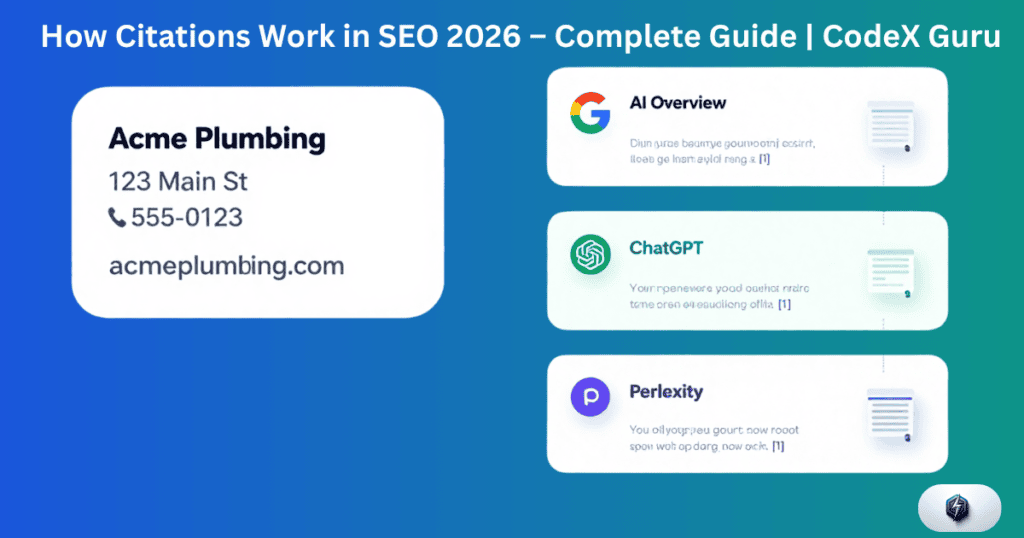
- In 2026, citations go beyond directories. AI search engines now cite websites in their answers. This is called GEO (Generative Engine Optimization).
- Consistent NAP data across the web can boost local pack rankings by up to 16% (Whitespark, 2025).
- Weak citations with wrong details hurt rankings. Strong citations with matching data help you rank higher.
- You need both structured citations (directories) and unstructured citations (blog mentions, news articles) for the best results.
Citations in SEO 2026 look different from what they were five years ago — and that gap keeps growing.
Do you run a local business? Or manage SEO for one? Then you need to understand how citations work in SEO. It is one of the most important things you can do to rank higher in local search.
Citations are one of the most important ranking signals for local search. And in 2026, they matter more than ever. That is because AI search tools like Google AI Overviews, ChatGPT, and Perplexity now pull data from cited sources.
This guide breaks down everything you need to know. We cover the basics, advanced strategies, and real examples. You will learn what works right now and what to avoid.
Let us start from the beginning.
What Are Citations in SEO?
A citation is any online mention of your business. It usually includes three things:
- Name – Your business name
- Address – Your street address
- Phone Number – Your contact number
Together, these three details are called NAP. NAP consistency means every listing shows the exact same name, address, and phone number — no exceptions. Search engines use NAP data to verify your business exists. They check if the data matches across many websites.
Think of it like references on a job application. The more people who confirm you are real and reliable, the more trust you earn.
According to Google’s business documentation, consistent business information across the web helps Google understand and display your business accurately.
Two Main Types of Citations
Not all citations look the same. There are two main types you need to know.
1. Structured Citations
These appear on business directories and listing sites. They follow a set format. Your NAP data goes into specific fields.
Common examples include:
- Google Business Profile
- Yelp
- Bing Places
- Apple Maps
- Yellow Pages
- Facebook Business Page
- Industry-specific directories (Avvo for lawyers, Healthgrades for doctors)
2. Unstructured Citations
These are mentions of your business in articles, blog posts, news stories, or social media. They do not follow a set format. But they still show search engines your business is being talked about.
Examples include:
- A local news article that mentions your store
- A blog post that reviews your service
- A podcast show notes page that links to your site
- A social media post that tags your business
Both types send trust signals to search engines. The best strategy uses a mix of both.
| Feature | Structured Citations | Unstructured Citations |
|---|---|---|
| Format | Fixed fields (Name, Address, Phone) | Free-form text mentions |
| Where Found | Directories, listing sites | Blogs, news, social media |
| Control Level | High – You enter data directly | Low – Others mention you |
| SEO Impact | Direct local ranking signal | Authority and trust builder |
| Example | Yelp business listing | Local newspaper article |
How Do Citations Help SEO Rankings?
Local SEO citations are one of the most cost-effective ways to improve your visibility in map results and near-me searches. Citations help your SEO in several clear ways. Let us walk through each one.
1. They Verify Your Business Exists
Search engines crawl the web and find your NAP data on different sites. When the data matches everywhere, Google gains confidence that your business is real.
2. They Build Trust and Authority
More citations from trusted websites mean more trust. A mention on a local chamber of commerce site carries more weight than a random low-quality directory.
3. They Improve Local Pack Rankings
The local pack is the map section at the top of Google search results. Citations are one of the top ranking factors for appearing there. According to Whitespark’s Local Search Ranking Factors study, citation signals account for approximately 7% of local pack ranking factors. This makes citation ranking factor data one of the clearest signals that directory listings still move the needle in 2026.
4. They Create Discovery Paths
When your business appears on Yelp, Apple Maps, or a local blog, people can find you through those platforms too. This creates multiple paths back to your business.
For a full walkthrough on setting up your local SEO foundation, check out our Local SEO Checklist 2026: Step-by-Step Guide. It covers everything from Google Business Profile setup to review strategies.
AI Citations: The New Frontier in 2026
Here is what has changed in 2026. Citations are no longer just about directories.
AI search engines now cite sources in their answers. When someone asks ChatGPT or Google AI Overview a question, the AI pulls information from websites. It then credits those websites with a citation link.
This is called Generative Engine Optimization (GEO). It is the practice of making your content easy for AI to find, understand, and cite. GEO citations are the new currency of AI-powered search — the more your content gets cited by AI tools, the more visible your brand becomes.
According to research from Turing College, “AI systems don’t cite content because it ranks well. They cite content they can extract a clean answer from and verify against other sources.”
How to Earn AI Citations
To get cited by AI tools, your content must follow some clear rules:
- Answer questions directly in the first 150 to 200 words of your content.
- Use clear, definitive language. Avoid vague phrases. State facts plainly.
- Add original data or proof. AI tools prefer content with unique statistics, case studies, or expert quotes.
- Structure your content well. Use headings, lists, and short paragraphs. This makes it easy for AI to extract answers.
- Include schema markup. This helps AI understand the context of your content.
Want to track where your content appears in search results and AI answers? Use our free SERP Analytics Tool to monitor your rankings and citation visibility across both traditional and AI-powered search.
💡 Expert Tip from David Connor: In 2026, I track two types of citation visibility for every client. First, I check traditional NAP citations on directories using audit tools. Second, I monitor which AI platforms cite their content. You need both to stay competitive. Our SERP Analytics Tool helps you track both in one place.
Weak vs Strong Citations: A Side-by-Side Comparison
Not all citations help your SEO. Some can actually hurt it. Let us look at the difference between weak and strong citations.
| Factor | ❌ Weak Citation | ✅ Strong Citation |
|---|---|---|
| Business Name | Joes Plumbing | Joe’s Plumbing LLC |
| Address | 123 Main St | 123 Main Street, Suite 4, Austin, TX 78701 |
| Phone | 5125551234 | (512) 555-1234 |
| Website URL | Missing | https://joesplumbingaustin.com |
| Category | Home Services | Plumber, Emergency Plumbing Service |
| Description | We do plumbing. | Joe’s Plumbing LLC provides 24/7 emergency plumbing, drain cleaning, and water heater repair in Austin, TX. Licensed and insured since 2012. |
| Photos | None | 5 high-quality photos of team, van, and completed jobs |
| Directory Quality | Spammy free directory | Yelp, BBB, local chamber site |
What Happens With Weak Citations?
When your citations are weak or inconsistent, bad things happen:
- Google gets confused about which version of your business is correct.
- Your local pack ranking drops or you do not appear at all.
- Customers find wrong phone numbers or old addresses. They lose trust.
- Duplicate listings appear. These split your ranking power.
- AI tools skip your business because the data does not match.
What Happens With Strong Citations?
When your citations are strong and consistent, good things happen:
- Google shows your business confidently in the local pack.
- You rank higher for “near me” searches in your area.
- Customers find the right information and contact you easily.
- AI search tools trust your data and may cite your website.
- Your overall domain authority grows as more quality sites link to or mention you.
📊 Real-World Example: The Impact of Citation Cleanup
A dental practice in Dallas had 47 citations across the web. But 23 of them had the wrong phone number because they changed their number in 2024. After fixing all 23 citations to match:
- Local pack visibility increased by 34% within 8 weeks.
- Phone calls from Google Business Profile went up by 22%.
- They moved from position 7 to position 3 for “dentist near me” in their city.
Source: Internal case study, CodeX Guru client data, Q1 2026. Results may vary.
How to Build Citations Step by Step
Follow these five steps to build strong citations that boost your rankings. This process works for any local business in any industry.
Step 1: Claim and Optimize Your Google Business Profile
Google Business Profile citations carry the most weight of any listing — get this one right before anything else. Make sure every field is filled out. Add photos, hours, services, and a detailed description. Keep your NAP exactly the same as on your website.
Step 2: Submit to Top-Tier Directories
Start with the most trusted platforms. These are the ones Google checks first.
- Yelp
- Bing Places
- Apple Maps (Apple Business Connect)
- Facebook Business Page
- Better Business Bureau (BBB)
- Yellow Pages / YP.com
Step 3: Add Industry-Specific Directories
Every industry has niche directories. These carry extra weight because they are relevant to your field.
- Restaurants: TripAdvisor, OpenTable, Zomato
- Lawyers: Avvo, FindLaw, Justia
- Doctors: Healthgrades, Zocdoc, Vitals
- Home Services: Angi, HomeAdvisor, Thumbtack
- Real Estate: Zillow, Realtor.com, Redfin
Step 4: Audit and Fix Existing Citations
A local citation audit is the fastest way to find and fix the data errors that are silently hurting your rankings. Search for your business name online. Check every listing you find. Look for:
- Old phone numbers
- Previous addresses
- Misspelled business names
- Duplicate listings
- Missing website URLs
Fix every error you find. This is one of the fastest ways to improve local rankings. Use tools like BrightLocal or Semrush Listing Management to speed up the process.
Step 5: Earn Unstructured Citations
This takes more effort but delivers the highest authority signals. Get mentioned in:
- Local news articles (pitch a story to local reporters)
- Guest posts on industry blogs
- Sponsorship pages for local events
- Podcast interviews and show notes
- Local community forums and groups
Each unstructured mention acts like a vote of confidence for your business. And in the age of AI search, these mentions help AI tools connect your brand to your expertise.
The 4-Tier Citation Building Strategy for 2026
A strong citation building strategy starts with the right tiers and works outward from the most trusted sources. Based on our analysis of top-performing local businesses, we recommend this 4-tier approach. It matches the strategy outlined by top SEO practitioners and aligns with current Google quality guidelines.
| Tier | Type | Examples | Priority |
|---|---|---|---|
| Tier 1 | Core Data Aggregators | Data Axle, Neustar Localeze, Foursquare | 🔴 Critical |
| Tier 2 | Major Platforms | Google, Yelp, Bing, Apple, Facebook | 🔴 Critical |
| Tier 3 | Industry + Local Directories | Niche directories, local chamber sites, BBB | 🟡 Important |
| Tier 4 | Earned Mentions | News articles, blog features, podcast mentions | 🟢 High Value |
Start with Tier 1 and work your way down. Most businesses never complete Tier 1 properly. That alone can give you an edge over competitors.
How to Do Citations for SEO?
This is one of the most common questions we hear. Here is a quick summary.
To do citations for SEO, start by claiming your Google Business Profile. Make sure your business name, address, and phone number are correct. Then submit that same exact data to other directories like Yelp, Bing Places, and Apple Maps.
Next, find and fix any old or wrong listings. Run a local citation audit using tools like BrightLocal to find inconsistencies fast. Finally, earn unstructured mentions by getting featured in local news, blogs, and community sites.
The key rule is NAP consistency. Every mention of your business online should use the exact same format. Even small differences like “St” vs “Street” or “LLC” vs no “LLC” can confuse search engines and cost you rankings.
For a detailed checklist you can follow right now, read our Local SEO Checklist 2026: Step-by-Step Guide.
What Are SEO Golden Rules in 2026?
SEO has evolved a lot. But in 2026, a few golden rules stand out. According to Elementor’s 2026 SEO Guide, the core rules are:
- Content must come from credible experts. Google values E-E-A-T (Experience, Expertise, Authoritativeness, Trustworthiness) more than ever.
- User experience matters. Fast sites, clean design, and mobile-friendly pages are non-negotiable.
- AI search is real. You must optimize for both traditional search engines and AI-powered search tools.
- Consistency wins. From citations to content publishing, regular and accurate information builds trust.
- Data-driven decisions. Use tools to track what works. Adjust based on results, not guesses.
You can track your search performance across both traditional and AI-powered results with the CodeX Guru SERP Analytics Tool. It helps you see where your content shows up and how your citations perform in real time.
How to Measure Citation Impact
Building citations is only half the job. You also need to track their impact. Here are the key metrics to watch.
Local Pack Position
Are you appearing in the map results for your target keywords? Track your position over time. If it improves after citation building, the strategy is working.
Google Business Profile Insights
Check how many people view, call, or get directions from your profile. These numbers should go up as your citations improve.
Website Traffic from Local Search
Look at your Google Analytics data. Filter for organic traffic from local searches. Watch for increases after you build or fix citations.
AI Citation Visibility
This is new for 2026. Check if AI tools mention your business or cite your content. You can do this manually by searching AI platforms. Or use our SERP Analytics Tool to automate the tracking and save hours every month.
Citation Accuracy Score
Tools like BrightLocal, Moz Local, and Semrush give you an accuracy score. This shows the percentage of your citations that have correct NAP data. Aim for 95% or higher.
Common Citation Mistakes to Avoid
Even experienced marketers make these errors. Avoid them to protect your rankings.
🚫 Citation Mistakes That Hurt Rankings
- Using different business names – “Joe’s Plumbing” on one site and “Joes Plumbing LLC” on another confuses Google.
- Ignoring old listings – If you moved or changed numbers, old listings with wrong data still exist. Find and fix them.
- Submitting to spammy directories – Low-quality directories add no value. They can even hurt you. Focus on trusted sites only.
- Not including website URL – Always add your website link. It creates a citation with a backlink, which is more powerful.
- Skipping description and categories – Fill out every field. More detail helps search engines understand your business better.
- Set and forget mentality – Citations need maintenance. Check them every quarter for accuracy.
Citations and E-E-A-T: Why Trust Matters
Google’s E-E-A-T framework (Experience, Expertise, Authoritativeness, Trustworthiness) directly connects to citations. Here is how:
- Experience: Unstructured citations in reviews and case studies prove you have real experience in your field.
- Expertise: Industry-specific directory listings show you are a recognized expert in your niche.
- Authoritativeness: Being mentioned on high-authority sites such as news outlets, government sites, and .edu domains builds authority fast.
- Trustworthiness: Consistent NAP data across many sources proves your business information is reliable and accurate.
In 2026, E-E-A-T is not optional. It is a core ranking signal. Citations are one of the easiest ways to build E-E-A-T for local businesses of any size.
Action Plan: Your Citation Strategy for the Next 30 Days
Use this plan to get started right away. Follow these steps in order for the best results.
📋 30-Day Citation Action Plan
Week 1: Run a local citation audit. List every place your business appears online. Note every error you find. Use BrightLocal or Semrush to speed this up.
Week 2: Fix all NAP inconsistencies. Update old phone numbers, addresses, and name variations. Remove duplicate listings wherever possible.
Week 3: Submit to Tier 1 data aggregators and Tier 2 major platforms. Make sure every field is complete. Do not leave anything blank.
Week 4: Submit to Tier 3 niche directories. Start outreach for Tier 4 earned mentions. Set up ranking tracking in the CodeX Guru SERP Analytics Tool.
Ongoing: Review citations every quarter. Track local pack position and Google Business Profile insights monthly. Monitor AI citation visibility weekly.
Final Thoughts
Understanding how citations work in SEO is the first step to building a stronger local presence. Citations are a foundational part of SEO in 2026. They work for local search, traditional rankings, and even AI-powered search results.
The rules are simple. Keep your business data consistent. Build citations on trusted platforms. Earn mentions from real sources. And track your results with the right tools.
If you do this well, you will see better rankings, more phone calls, and more customers finding your business online. Every step in this guide is something you can act on today — no big budget needed.
Start with our Local SEO Checklist 2026 to build your full local SEO foundation. Then track your progress and citation visibility using the CodeX Guru SERP Analytics Tool. Both are free and built to help businesses like yours win in search.
📚 Sources and References
- Whitespark – Local Search Ranking Factors 2025
- Google – Business Information on Google
- Google Search Central – Creating Helpful Content
- Turing College – From SEO to GEO: Making Content Citable in 2026
- Elementor – What Is SEO: A Comprehensive Guide for 2026
- SEO Inc – AI and SEO in 2026
- Crawl Vision – AI Citations in SEO 2026
- Search Engine Land – Mentions, Citations, and Clicks: 2026 Content Strategy
- BrightLocal – Citation and Local SEO Tools
About the Author
David Connor is an SEO strategist and the founder of CodeX Guru. He specializes in programmatic SEO, local search optimization, and generative engine optimization (GEO). With over a decade of experience helping businesses rank in competitive markets, David writes practical guides that turn search data into real results.
🌐 codexguruu.com | 🏢 CodeX Guru | 📍 United States
✅ Expert-Written Content | 📊 Data-Backed Research | 🔄 Updated July 01, 2026 | 🏢 Published by CodeX Guru | ✍️ Author: David Connor